

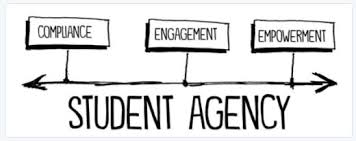
When do students engage in their own learning most deeply?
When they have a locus of control, students will dive deeply!
Student agency—the capacity of learners to make meaningful decisions about their own education—is one of the most powerful predictors of academic motivation, belonging, and long-term success. Yet most schools still organize learning in ways that systematically remove it.
The good news: changing that starts at the top. When school leaders intentionally design systems, structures, and culture around student voice and ownership, classrooms follow. This post explores what the research says, what high-agency schools actually look like, and the concrete steps leaders can take—starting now.
What Is Student Agency, Really?
Student agency is more than offering choices. It’s the experience of being a genuine author of one’s own learning—having a voice in what is studied, how mastery is demonstrated, and why it matters. Researchers often describe it along a spectrum:
Voice
Students are invited to share opinions and experiences. Their input is acknowledged but may not change course.
Choice
Students choose among meaningful options—topics, formats, and pacing—within a structured framework set by the teacher.
Co-Creation
Students shape what is studied and co-author success criteria. Learning goals are genuinely shared between teacher and student. Middle schoolers in particular dive into negotiated curriculum models.
Leadership
Students design learning experiences—for themselves and often for others. They become teachers, researchers, and community problem-solvers.
Most schools operate primarily on the development of student voice. This is a step towards increasing student agency. A culture of agency requires moving deliberately and sustainably toward co-creation and leadership— a shift demands intentional leadership, not just inspired teaching.
Why It Matters: The Research Case
The evidence linking student agency to meaningful outcomes is both broad and deep. Leaders who understand this research are better equipped to make the case to school boards, skeptical staff, and families.
73% of students with high agency report stronger motivation to attend school
(Quaglia & Corso, 2014)
2×more likely to demonstrate deep learning behaviors when students feel genuine ownership
(OECD, 2019)
40% reduction in chronic absenteeism in schools with strong student voice structures
(Attendanceworks, 2021)
A landmark study by Reeve & Tseng (2011) found that students in autonomy-supportive classrooms showed significantly higher levels of engagement, conceptual understanding, and intrinsic motivation—even when controlling for prior achievement.
Critically, the effect was strongest for students who had historically experienced the least agency: students from low-income households, English language learners, and students with IEPs.Reeve, J., & Tseng, C. M. (2011). Agency as a fourth aspect of students’ engagement during learning activities. Contemporary Educational Psychology, 36(4), 257–267.
When students believe they have control over their learning and that their contributions matter, the brain’s threat-detection systems quiet—making deep learning neurologically possible. Zaretta Hammond, Culturally Responsive Teaching and the Brain (2015)
The OECD’s 2019 Learning Compass framework identifies student agency as a core competency for navigating an uncertain future. Nations with the highest PISA scores in student well-being (not just academics) consistently show strong systemic support for student voice in school governance, curriculum design, and assessment. OECD (2019). OECD Future of Education and Skills 2030: Conceptual Learning Framework. Paris: OECD Publishing.
Closer to home, the work of psychologists Edward Deci and Richard Ryan on Self-Determination Theory (SDT) has demonstrated across decades of research that human beings have three core psychological needs: autonomy, competence, and relatedness. Schools that design around these needs produce students who are not just higher achieving but genuinely invested in learning as a lifelong pursuit.
The Leader’s Unique Role
Teachers can design and develop agency-rich classrooms in isolation (I have done this, and it is pretty lonely). The risk of burnout is constant, and students are stuck leaving one system where they feel that they have control, to classes that are being “done to them.” School-wide agency culture requires something only leaders can provide: structural permission and systemic design. I would never have been able to design classrooms for student agency if a brave administrator had not given me permission to take chances, make mistakes, and work in the best interest of my students.
Researchers Linda Darling-Hammond and Jal Mehta describe this as the difference between pockets of excellence and excellence as the norm. Individual teachers can do powerful work; principals and district leaders determine whether that work gets replicated, protected, and grown—or quietly suffocated by compliance culture.
You cannot build a culture of student agency inside a culture of adult compliance. The two are structurally incompatible. School leaders must decide which one they are designing for. Jal Mehta & Sarah Fine, In Search of Deeper Learning (2019)
The leader’s role is not to be the most agency-giving teacher in the building. It’s to create the conditions under which every teacher is empowered—and structurally supported—to do that work with every student.
Starting Points for School Leaders
Audit your school’s current agency architecture
Before adding anything new, examine what already exists. Walk your school through the lens of a student. Where do students make genuine decisions? Where are their receivers? Survey students—not about satisfaction, but about ownership: “Do you feel like you have a real say in what happens here?” The gap between what leaders believe and what students report is almost always significant—and always instructive.
Create formal structures for student voice in governance
Student advisory councils that have no decision-making power are performance, not practice. High-agency schools include students in hiring panels, curriculum review committees, professional development design, and school improvement planning. When students know their input shapes real decisions, they engage differently — and so do adults.
A 2018 study by the Student Voice Research Collaborative found that schools with formal student roles in governance decisions showed 34% higher student trust in school leadership and significantly lower rates of disciplinary incidents.Mitra, D. (2018). Student voice in school reform. Phi Delta Kappan, 100(3), 20–25.
Align professional development to agency-centered pedagogy
Teachers teach the way they were taught — and the way they are trained. PD that models top-down transmission will produce teachers who transmit. PD that models agency, inquiry, and co-creation will produce teachers who facilitate it. Leaders must design PD with the same intentionality they want teachers to bring to lesson design: student-centered principles applied to adult learning.
Protect time and space for inquiry-based learning
The single biggest barrier teachers cite to student-centered learning is time — specifically, the pressure to cover content. Leaders can directly address this by auditing the master schedule for inquiry time, protecting electives and project blocks, reducing mandatory curriculum pacing requirements, and publicly celebrating deep learning over content coverage. What you protect signals what you value.
Redesign assessment policy to center student self-knowledge
Traditional grading systems often undermine agency by positioning the teacher as the sole arbiter of quality. Leaders can shift this by piloting standards-based grading, building self-assessment into school-wide assessment policy, championing portfolio models and student-led conferences, and training teachers in conferencing practices that position students as experts on their own learning.
Build belonging and identity affirmation into every system
Agency and belonging are inseparable. Research by Walton and Cohen demonstrates that students who feel they do not belong in an academic community will withdraw agency — even when it is offered. Leaders must examine whose stories are told in curriculum, whose knowledge is treated as valid, who is represented in staff and leadership, and whose families feel welcomed as partners. Belonging is not a counseling initiative — it’s a leadership design question.
Model agency in your own leadership practice
Perhaps the most underestimated best practice: school culture mirrors principal behavior. Leaders who share decision-making with staff, ask for genuine feedback and act on it, acknowledge uncertainty, and invite disagreement create the psychological permission structure for agency to cascade downward. Leaders who maintain tight top-down control — even with good intentions — model exactly the opposite of what they’re asking teachers to do.
Addressing Barriers
| Barrier | Why it persists | Leadership response | Difficulty |
|---|---|---|---|
| “We don’t have time for this.” | Genuine pressure from curriculum pacing, standardized testing, and accountability metrics. | Audit content coverage requirements, negotiate with the district on pacing flexibility, and publicly reframe deep learning as the goal—not content consumption. | Moderate |
| “Students aren’t ready for this kind of responsibility.” | Low expectations, often driven by deficit thinking about specific student populations. | Share disaggregated data on which students are denied agency most often. Facilitate professional conversations about implicit bias in expectations. | High |
| “Parents will push back.” | Families unfamiliar with non-traditional models often worry about rigor or college readiness. | Proactively share research; host family information nights; create opportunities for families to observe agency-rich learning in action. | Moderate |
| “Our curriculum is too prescribed.” | Rigid adoption mandates or scripted curricula leave little room for teacher or student discretion. | Identify flex time within mandated programs; advocate at the district level; document how agency-centered adaptations improve outcomes. | High |
| “Teachers aren’t trained for this.” | Teacher preparation programs rarely develop facilitation, inquiry design, or student conferencing skills. | Redesign PD calendar; bring in coaching support; create peer observation and lab classroom programs; reduce initiative overload. | Manageable |
| “We’ll lose control of learning outcomes.” | Fear that student choice undermines rigor or leads to gaps in foundational skills. | Share research on agency and achievement; pilot in contained contexts first; track data carefully and share results with staff. | Manageable |
A Leadership Action Framework: Your guide to Now, Next, Later
Building agency culture is not a one-year initiative — it’s a multi-year transformation. The framework below helps leaders sequence their work without trying to do everything at once.
Now (Year 1)
Listen and learn. Survey students and staff. Conduct walkthroughs with an agency lens. Identify 2–3 teachers already doing this work and amplify them. Run one pilot agency-focused PD session. Establish a student advisory panel with real input on one decision.
Next (Year 2)
Build infrastructure. Revise PD calendar to center student-centered pedagogy. Pilot standards-based or portfolio assessment in 2–3 classrooms. Integrate student voice into the school improvement plan. Redesign onboarding for new teachers to include agency frameworks.
Later (Year 3+)
Embed and sustain. Agency-centered practices written into hiring criteria and teacher evaluation. Students regularly presenting to the board. School-wide assessment model centers self-assessment and student-led conferences. New teachers are mentored into this culture by veterans.
Research on school improvement by Bryk et al. (2010) found that school-wide instructional change that lasts requires four key conditions: professional community, program coherence, trust in leadership, and a focus on student learning as the organizing principle. Student agency culture, when built well, requires and reinforces all four. Bryk, A. S., Sebring, P. B., Allensworth, E., Luppescu, S., & Easton, J. Q. (2010). Organizing Schools for Improvement: Lessons from Chicago. University of Chicago Press.
Self-Assessment Questions for Leaders
Strong leaders ask hard questions of themselves before asking them of others. Use these prompts to evaluate where your school currently stands — and where you want to take it.
Questions for School Leaders
- In the last month, what did students at your school have a genuine say in—where their input shaped a real decision?
- Which students in your building have the least agency? Is that pattern correlated with race, income, disability status, or language background?
- What would a student who struggles academically say about whether this school feels like it was built for them?
- Does your professional development model the pedagogy you want to see in classrooms—or does it contradict it?
- What have you publicly canceled, reduced, or protected in the last year to create space for deeper learning?
- What would your school look like if students designed one element of it from scratch?
The Work Starts With You
Building a culture of student agency isn’t a program to implement — it’s a belief system to embody. It begins with a fundamental conviction that students are not problems to manage or vessels to fill, but people with knowledge, experiences, and ideas that make learning richer for everyone in the room.
The research is clear. The practitioners who have built this culture prove it works. The students who experience it will tell you it changes everything.
The goal is not to give students more freedom. The goal is to build institutions worthy of their full participation. Adapted from John Dewey, Democracy and Education (1916)
That work starts at the top — with leaders willing to audit, redesign, model, and protect the conditions under which every student gets to be an author of their own learning.
With guidance and support, administrators can be the catalyst for changes that result in a large return on their investment. Invest in teachers, and watch how students respond.